Is my Design system AI ready ?

Goal

Explore how an AI agent can interact with a design system inside Figma, and how well LLMs understand and evaluate system structure, naming, and usage .

What I tried and how

Connected Figma MCP server with Claude and used prompts to analyze my design system directly from Figma. Explored multiple use cases to understand AI agent can interact with system-level design:

  1. Tested how well the design system can be read and interpreted by AI

  2. Ran system-level checks to identify inconsistencies, broken instances, and missing adherence to patterns

  3. Attempted to generate usability audits for the design system

  4. Tried to get AI to add annotations/comments directly in Figma (not supported yet)

  5. Explored improving the design system by refining component naming, structure, and guidelines based on AI feedback

Outcome

Claude was able to directly interact with Figma through MCP — writing into files, generating variables, and creating components and their variants. This made it useful not just for exploration, but as an active participant in building and extending the design system.

Alongside this, it was also able to analyze the design system and generate a structured report highlighting broken instances, inconsistencies, and missing adherence to system rules. It provided direct links to elements, making it easier to navigate and fix issues.
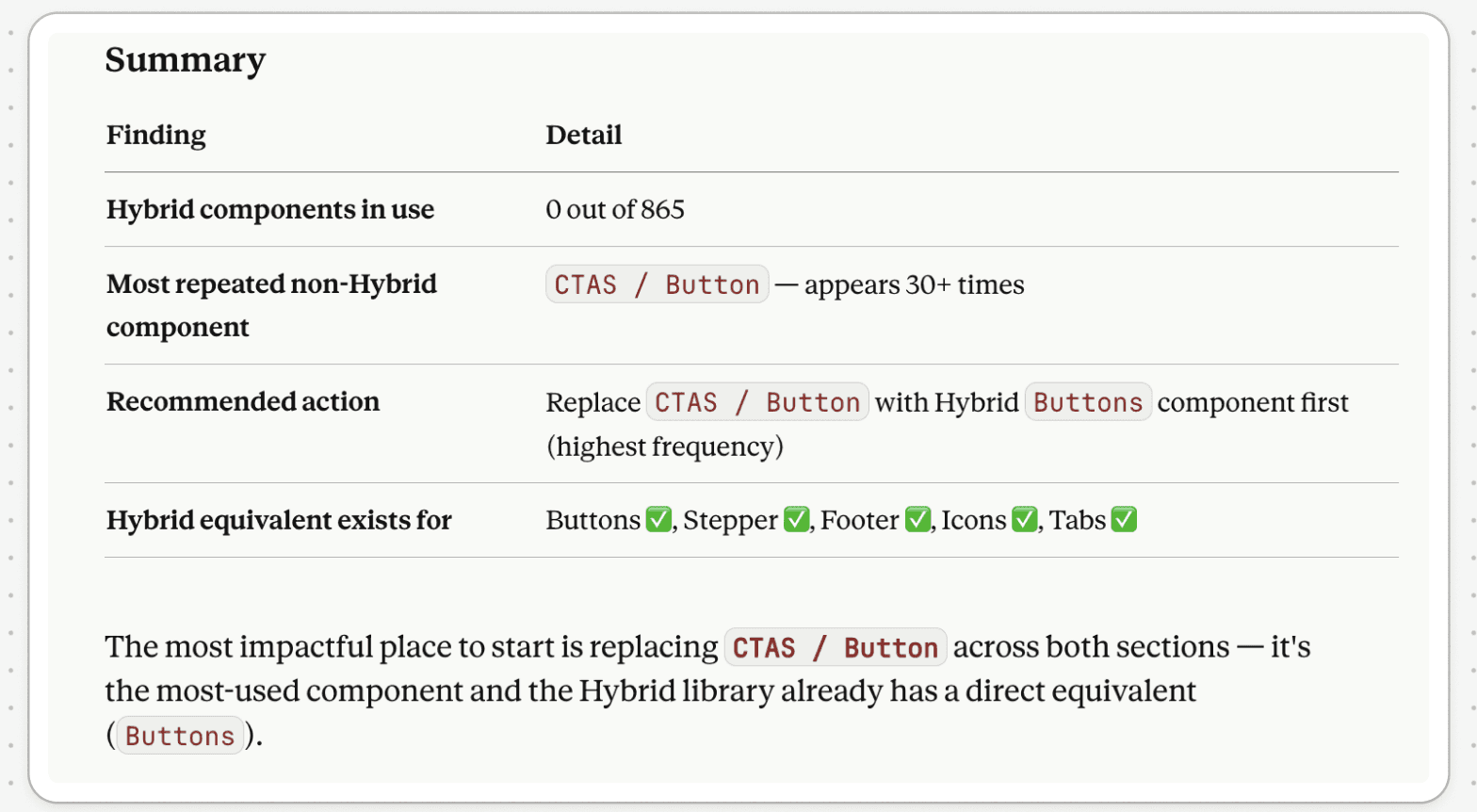
However, it couldn’t add annotations directly in Figma, which limited in-context usability and made the workflow slightly fragmented.

Learning and Insights

Learning and Insights

This exercise made it clear that design systems need to be much more explicit and structured for AI to understand them properly. Clear naming, consistent patterns, and well-defined usage guidelines significantly improved the quality of AI output.

Found that AI can be effective in auditing and identifying issues which can save time for testing the designs and maintaining the consistency as well , but current limitations (like inability to annotate directly in design files) break the workflow slightly.

Most importantly, it reinforced that design systems are becoming a critical foundation for working with AI. Without strong structure and clarity, outputs can easily become inconsistent — especially in enterprise-level products. I also posted about this on Linkedin , link to the post - Design system importance in AI era

This exercise made it clear that design systems need to be much more explicit and structured for AI to understand them properly. Clear naming, consistent patterns, and well-defined usage guidelines significantly improved the quality of AI output.

Found that AI can be effective in auditing and identifying issues which can save time for testing the designs and maintaining the consistency as well , but current limitations (like inability to annotate directly in design files) break the workflow slightly.

Most importantly, it reinforced that design systems are becoming a critical foundation for working with AI. Without strong structure and clarity, outputs can easily become inconsistent — especially in enterprise-level products. I also posted about this on Linkedin , link to the post - Design system importance in AI era