Can AI give the right gaming experince ?

Goal

Experiment with AI-generated games by recreating a childhood memory game, but with a twist — introducing AI as the opponent. The idea was to explore how well AI could handle both game logic and overall experience.

What I tried and how

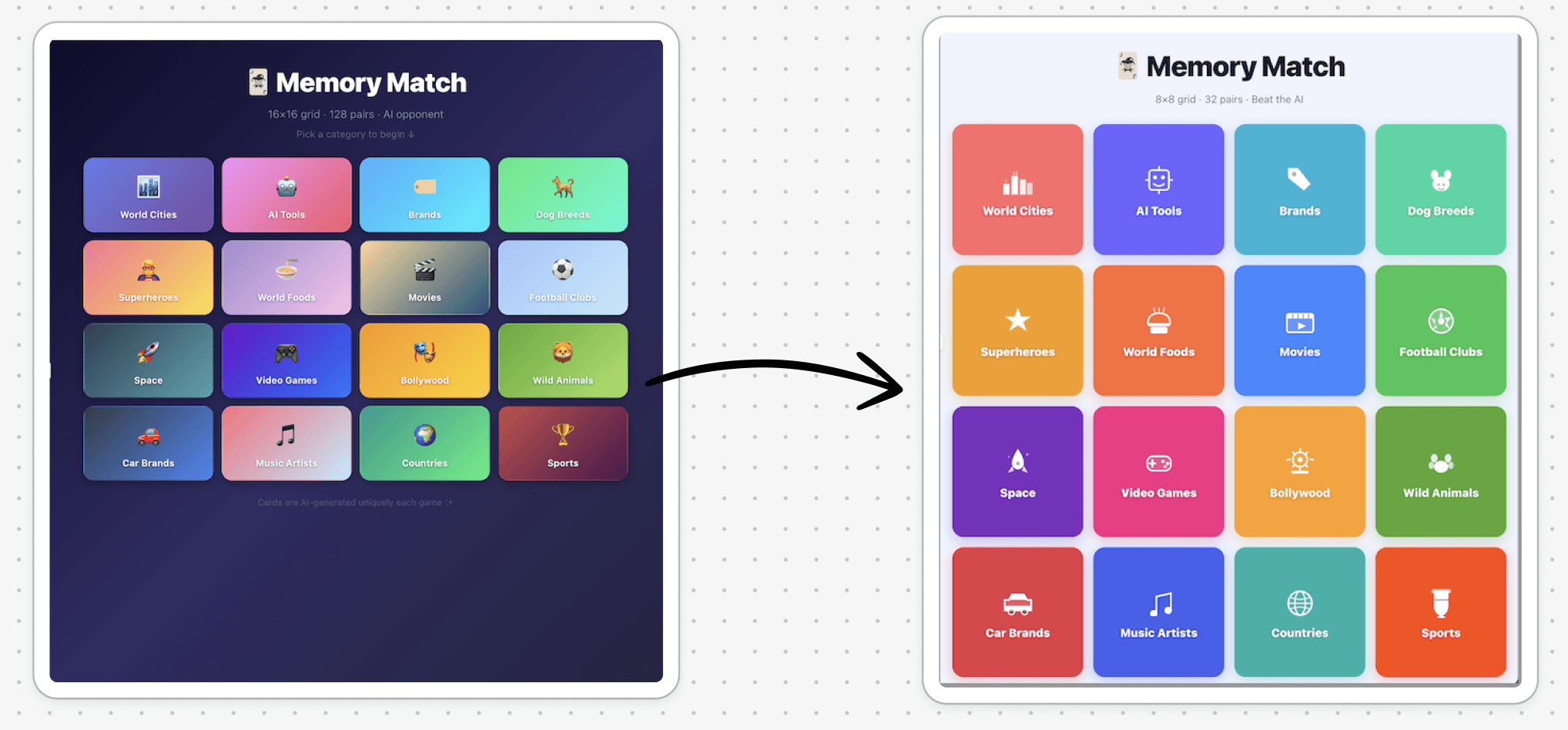
Started with a simple prompt describing the game and the AI opponent. The initial output handled the core logic well but lacked engaging visuals. Iterated by adding more contextual prompts around visual direction — specifically asking for bold, engaging colors and a more playful interface to make the experience feel enjoyable and repeatable. Here are 2 screenshots of before and after visual direction .
Outcome

Was able to build a functional memory game quickly, with solid game logic handled by AI but not engaging visuals . Visual quality improved significantly after adding explicit direction, resulting in a more engaging and playable experience compared to the initial output.

Give yourself a chance with the memory game : Memory game

Learning and Insights

Learning and Insights

Learned that AI can handle structured logic (like game rules) quite reliably, but struggles with experience quality unless guided clearly. The initial version worked functionally, but didn’t feel engaging enough to play repeatedly and this made me validate what I learned in a course " How to build products people love " .

The usability alone isn’t enough — visual design and emotional engagement play a huge role in how much users want to interact with a product.

Overall, AI helped accelerated the build, but the difference between a working product and an engaging one came down to intentional design decisions.


Learned that AI can handle structured logic (like game rules) quite reliably, but struggles with experience quality unless guided clearly. The initial version worked functionally, but didn’t feel engaging enough to play repeatedly and this made me validate what I learned in a course " How to build products people love " .

The usability alone isn’t enough — visual design and emotional engagement play a huge role in how much users want to interact with a product.

Overall, AI helped accelerated the build, but the difference between a working product and an engaging one came down to intentional design decisions.